
Best EHR for PT, OT, and SLP Clinics

If you run a physical therapy, occupational therapy, or speech-language pathology practice, you already know how much your EHR can make or break your day. The right system handles documentation, billing, scheduling, and compliance without slowing your clinicians down. The wrong one creates bottlenecks that follow you into every session.
So which EHR is actually worth it for therapy practices?
What Should a Great Therapy EHR Actually Do?
Before diving into the tools, it helps to know what you are evaluating. A strong EHR for therapy practices should handle clinical documentation with discipline-specific templates (SOAP notes, daily notes, evaluation templates), billing and insurance claim submission, scheduling and appointment management, outcome tracking tools (like functional outcome measures built in), patient portal access, and ideally, some level of telehealth support.
The platforms below are ranked and reviewed with all of that in mind.
#1: WebPT
WebPT is the most widely adopted EHR specifically built for physical therapy, occupational therapy, and speech-language pathology practices. It launched in 2008 and has grown into the dominant platform for outpatient rehab therapy. It includes documentation, scheduling, billing, outcome tracking, home exercise programs, and a patient portal under one roof.
Pros
Purpose-built for rehab therapy disciplines, so the templates feel natural
Strong outcome measures library built directly into the workflow
Robust billing and revenue cycle management tools
FOTO (Focus on Therapeutic Outcomes) integration for outcomes reporting
Home exercise program (HEP) builder included
Cons
Pricing is on the higher end compared to general-purpose EHRs
Some users report that customer support response times can be slow
The interface can feel dated compared to newer platforms
Setup and onboarding has a learning curve for larger teams
Find real reviews here: G2 – WebPT
2: Clinicient (now part of Net Health)
Clinicient, now operating under the Net Health umbrella, offers an EHR and billing platform specifically tailored to outpatient therapy. It is especially popular with mid-to-large therapy groups and hospital-affiliated outpatient departments. Net Health acquired Clinicient in 2021, expanding its reach across skilled nursing, home health, and outpatient rehab.
Pros
Strong revenue cycle management and denial tracking
Designed specifically for outpatient rehab therapy
Outcomes tracking and compliance reporting built in
Good fit for multi-location practices and enterprise groups
Cons
The acquisition by Net Health has caused some users to experience changes in support structure
Smaller solo practices may find the system more robust than they need
Pricing is not publicly listed and requires a demo to get a quote
#3: Therabill (now part of WebPT)
Therabill was a well-known billing and practice management platform for therapy practices before WebPT acquired it. It now operates as a billing-focused tier within the WebPT ecosystem. If your primary pain point is billing and insurance claim management rather than full documentation, Therabill's focused approach may be worth exploring within the WebPT suite.
Pros
Streamlined billing workflows designed for therapy practices
Strong claim scrubbing and submission tools
Integrates cleanly with WebPT documentation
Useful for practices that outsource or co-manage billing separately
Cons
Since the acquisition, product development has shifted to integration with WebPT rather than standalone improvements
Solo practitioners looking for a standalone product may need to reconsider options
Limited telehealth features
Find real reviews here: Capterra – Therabill
#4: SimplePractice
SimplePractice is a practice management and EHR platform popular across behavioral health, speech therapy, and occupational therapy. It is particularly well-suited for solo practitioners and small group practices. Features include documentation, scheduling, telehealth, billing, and a polished client-facing portal.
Pros
Clean, intuitive interface that is easy to learn
Strong telehealth integration included in most plans
Client portal with intake forms, messaging, and billing
Good documentation templates for SLP and OT workflows
Mobile app is well-designed for documentation on the go
Cons
Not purpose-built for physical therapy, so PT-specific documentation templates are less developed
Customer support is primarily email-based, which frustrates users who need phone support
Outcome measures and functional reporting are not as robust as PT-specific platforms
Find real reviews here: G2 – SimplePractice
#5: Kareo (now Tebra)
Kareo merged with PatientPop to become Tebra, a broader healthcare practice management and EHR platform. It serves a wide range of outpatient specialties, including PT, OT, and SLP. Tebra is particularly well-regarded for its billing and revenue cycle tools, along with marketing and online presence features that help practices attract new patients.
Pros
Strong billing tools with real-time eligibility verification
Marketing and online reputation management features included
Good for multi-specialty practices
Telehealth integrated into the platform
Cons
The merger transition from Kareo to Tebra introduced some feature inconsistencies that users noticed
Therapy-specific documentation templates are less developed than PT-first platforms
Some users report billing support can be inconsistent
Find real reviews here: Trustpilot – Tebra
#6: TheraNest
TheraNest is a practice management and EHR platform designed primarily for mental health and behavioral health providers, but it has gained a user base among speech-language pathologists and occupational therapists who appreciate its clean documentation and billing tools. It is especially popular with solo practitioners and small group practices.
Pros
Affordable pricing with a tiered model based on active clients
Clean, easy-to-navigate interface
Telehealth included in most plans
Solid customer support reputation
Good client portal with intake form automation
Cons
Template depth for PT and OT disciplines is limited compared to rehab-specific platforms
Outcome measures library is not as comprehensive as WebPT or Clinicient
Less suited for high-volume PT clinics with complex billing
Find real reviews here: G2 – TheraNest
#7: Fusion Web Clinic
Fusion Web Clinic is a pediatric therapy-focused EHR built specifically for PT, OT, and SLP practices that serve children. If your clinic works primarily with pediatric patients in school-based, clinic-based, or early intervention settings, Fusion Web Clinic stands out as one of the few platforms truly designed for that population and workflow.
Pros
Purpose-built for pediatric PT, OT, and SLP
Templates designed for pediatric documentation requirements
School-based therapy documentation support
Scheduling and billing tools suited to pediatric practice patterns
Strong customer support reputation
Cons
Limited to pediatric-focused practices, so adult therapy clinics would not be a good fit
Fewer third-party integrations compared to larger platforms
Reporting tools are functional but not as advanced as enterprise platforms
Find real reviews here: G2 – Fusion Web Clinic
#8: drchrono
drchrono is a flexible EHR and practice management platform that serves a wide range of specialties, including physical therapy, occupational therapy, and speech-language pathology. It is Apple-first in its design philosophy and works exceptionally well on iPad, which makes it popular with clinicians who prefer tablet-based documentation. drchrono also offers a free tier, which is unusual in the EHR market.
Pros
Excellent iPad and mobile documentation experience
Free plan available for solo practitioners (with limitations)
Highly customizable note templates
Strong API for integration with other tools
Apple Health integration
Cons
Customer support on lower-tier plans can be difficult to access
Therapy-specific templates require customization rather than being pre-built for PT/OT/SLP
Billing features on the free tier are very limited
Some users report inconsistent update quality
Find real reviews here: G2 – drchrono
#9: Prompt Therapy Solutions
Prompt is a newer, cloud-based EHR and practice management platform built specifically for rehab therapy practices. It has grown quickly by targeting the gap between legacy PT-specific platforms and modern, clean-interface tools. Prompt covers documentation, scheduling, billing, reporting, and analytics with a particular emphasis on operational visibility for practice owners.
Pros
Modern, clean interface with a short learning curve
Strong operational reporting and business analytics for practice owners
Built specifically for PT, OT, and SLP workflows
Active product development with frequent feature updates
Responsive customer support
Cons
Newer platform, so the feature set is still maturing in some areas
Fewer third-party integrations compared to established platforms
Some users report that billing features, while improving, are not yet as robust as WebPT
Find real reviews here: G2 – Prompt Therapy Solutions and Capterra – Prompt
#10: Netsmart myUnity / myEvolv
Netsmart is an enterprise-level health IT company serving behavioral health, post-acute care, and human services organizations. Their platforms, myUnity and myEvolv, are used by large therapy groups, hospital-owned outpatient departments, and multi-site providers who need robust integration with broader healthcare systems. This is an enterprise tool, not a solo-practice solution.
Pros
Deep integration capabilities with hospital systems and HIEs
Strong compliance and regulatory reporting tools
Suited for complex, multi-location or multi-specialty organizations
Robust billing for high-volume environments
Cons
Implementation is complex and requires dedicated IT involvement
Not suited for small or solo therapy practices
Pricing is enterprise-level and requires a full sales process
User interface has been described as dated compared to modern platforms
Find real reviews here: G2 – Netsmart
How to Choose the Right EHR for Your Practice
The "best" EHR depends entirely on what kind of practice you run. A solo SLP doing telehealth will have completely different needs than a 10-therapist PT clinic with complex insurance billing.
Here is a practical way to narrow it down.
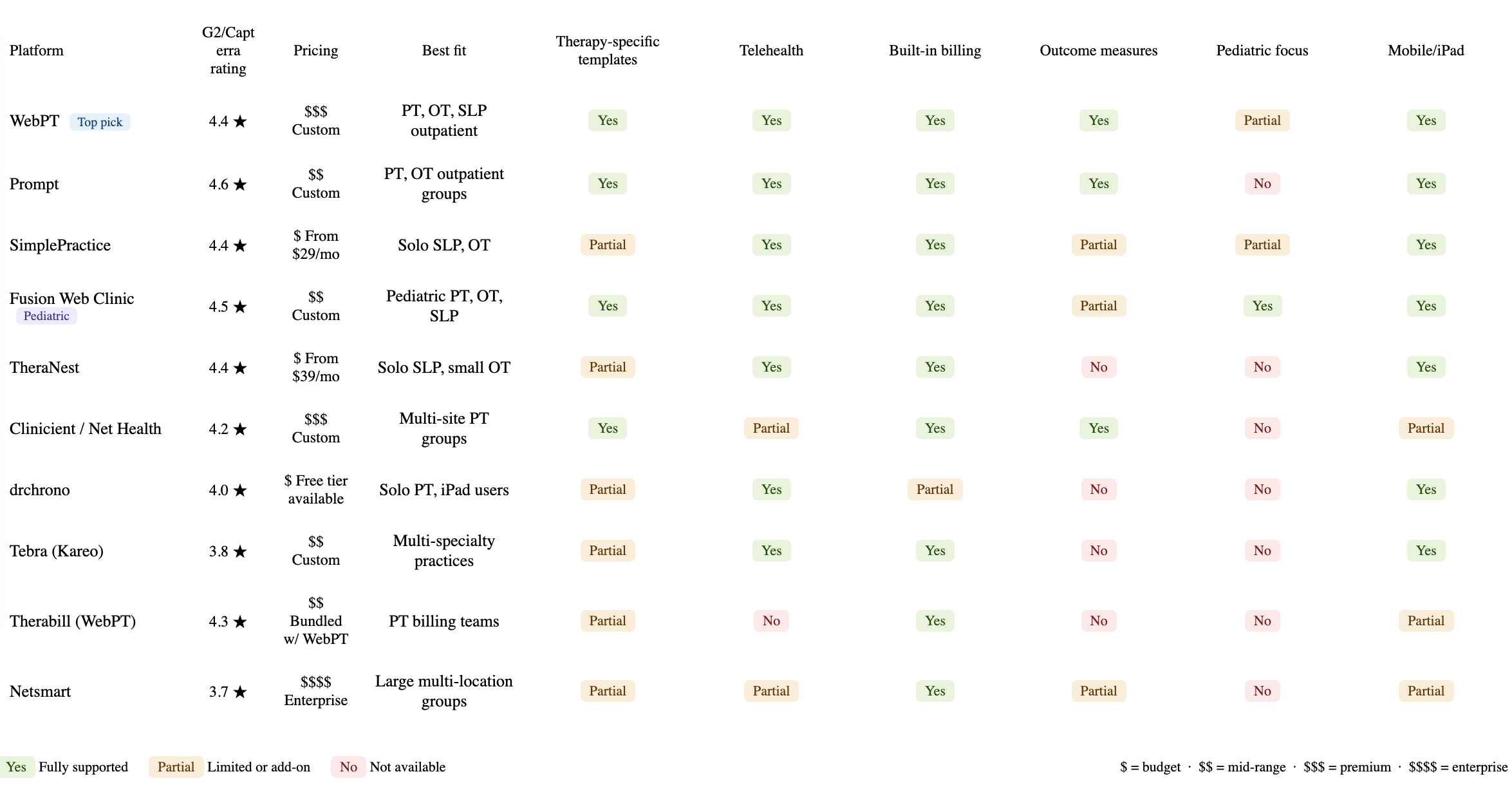
If you are a solo or small practice in PT, OT, or SLP doing telehealth, SimplePractice and TheraNest are strong starting points. If you run an outpatient PT or multi-discipline therapy clinic and billing is your primary pain point, WebPT and Prompt are the most purpose-built options with the deepest owner satisfaction scores. If your practice focuses on pediatric patients, Fusion Web Clinic is in a category of its own. And if you are managing a multi-location or enterprise-level group, Clinicient (Net Health) or Netsmart belong in your evaluation.
Choosing the right EHR is only one part of running an efficient clinic. Many practice owners find that the administrative load around their EHR, including scheduling coordination, insurance follow-ups, patient communication, and documentation support, is just as demanding as clinical work.
That is exactly where a trained virtual assistant can close the gap. Virtual Rockstar specializes in placing pre-vetted VAs with physical therapy, occupational therapy, and speech-language pathology practices. Our assistants are highly-experienced in therapy workflows and can work directly inside your EHR system from day one.
If your admin overhead is slowing your practice down, we can help. Learn more about how Virtual Rockstar supports therapy practices at virtualrockstar.com.
Frequently Asked Questions
What is the best EHR for a solo PT practice?
For a solo physical therapist, WebPT and Prompt are the most therapy-specific options with strong documentation templates. If you also want built-in telehealth and an affordable starting price, SimplePractice is worth evaluating. The right fit depends on your billing complexity and how much customization you want from your templates.
Which EHR works best for speech-language pathology?
SimplePractice and TheraNest are popular among SLPs, especially in private practice, because of their clean interfaces and telehealth integration. For SLPs treating pediatric patients, Fusion Web Clinic is one of the few platforms with templates and workflows specifically designed for pediatric speech therapy documentation.
Is there a free EHR for therapy practices?
drchrono offers a free tier for solo practitioners, though billing features are limited at that level. Most therapy-specific EHRs require a subscription, with pricing typically ranging from $99 to $300+ per month depending on practice size and features. Most platforms offer a free trial or demo before purchase.
How long does it take to switch EHR systems?
Most therapy practices report that a full EHR transition takes four to eight weeks from setup to full adoption. This includes data migration, template customization, staff training, and billing workflow changes. Having a dedicated team member or virtual assistant manage the administrative side of the transition can significantly reduce the disruption.
What should I look for in a therapy EHR demo?
During any demo, test the documentation workflow for your most common note type, ask about billing denial rates from current customers, check how the scheduling and waitlist management works, and ask specifically about support response time and how updates are communicated. Real owner feedback from platforms like G2 and Capterra will tell you more than the demo itself.
